Wednesday, December 16, 2009

Phantom

This is in my series on Paintball guns.  You can find the introduction here.


The Phantom is the standard for higher-end modern "stock" players.  Unlike most people who play paintball, stock players use old-fashioned "pump" guns that must be re-cocked after each shot.  They also typically limit themselves to 12-gram CO2 cartridges (like the original markers used) and a 10- to 15-shot magazine tube located on the top of the marker (also like the originals).
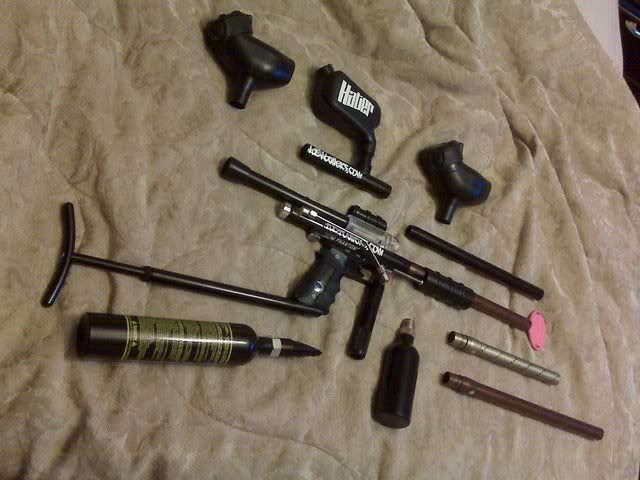
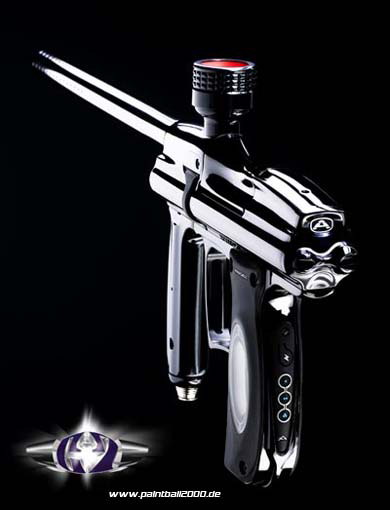
These markers are extremely customizable.  They offer different barrel lengths, different shoulder stock options, different CO2 canister locations, different color schemes, and different handle styles.  The average marker looks like one of the two pictured above, though.  It is simple and useful.  I would personally like a shoulder stock on it to help hold the marker steady for shots, because you will only be able to shoot one ball to the opponent's 15 and you have to make that ball count.

Here is a picture illustrating the number of upgrades available, and it only scratches the surface.


Nasty Typhoon

This is in my series on Paintball guns.  You can find the introduction here.


 This is one of the most ridiculous paintball guns out there.  Called a "Nasty Typhoon", it is a Typhoon modified to fire out of two barrels simultaneously.   It, like all Semi-automatic paintball guns, fires once with every pull of the trigger.  It runs off of CO2 or HPA, and is very rare.

This marker is potentially too much for me.  The lack of a stock would make it hard to handle, and the double barrel, though it looks very cool, would most likely have an adverse effect on performance without offering that much "hit potential" in return.

The other thing to consider is the "life-like" look of this marker.  The double barrels scream "real gun" louder than most other things can.  Some other paintball markers (like the Tippman SMG60) technically look more realistic than this, but in terms of scaring people on the street, this takes the cake.  The designers should keep these considerations in mind when designing these markers, or else the sport will lose popularity and eventually become outlawed.

Some other "versions" of the Nasty Typhoon are considerably better at keeping "the public" from panicking.  For example, this next picture shows a version with blue and silver annodizing that makes it look much more like entertainment than death waiting to happen.


Angel

This is in my series on Paintball guns.  You can find the introduction here.


The Angel is considered by most to be the pièce-de-résistance of paintball technology.  It is fully electro-pneumatic, meaning that everything is electronically controlled.  In a standard paintball gun, a mechanical sear holds the bold back until the trigger is pulled.  Then the bold moves forward and strikes the valve which releases a burst of gas.  Some of this gas is used to propel the ball out of the barrel, and the rest is used to push the bolt back against the sear, resetting it for the next shot.
However, in an Angel, everything is electronically controlled, from the amount of air released to the cycling of the action.  This allows for almost no moving parts, and makes the entire gun extremely precise, accurate, and programmable for different modes of fire.
This comes at a high cost, though, as the average Angel costs around $1000 without upgrades.  It also cannot take the relatively coarse nature of CO2, so must be run on HPA.
Since Angels are so expensive, the average player customizes his marker to reflect his personal style.  Here is a good example.


Tippman 98 Custom

This is in my series on Paintball guns.  You can find the introduction here.


The Tippmann 98 Custom is the "standard" for recreational paintball guns.  It is rock-solid (there are several well-recorded tests where a player will immerse his gun in sand, cycle the action, then pull it out and fire it without any problems) and relatively simple and easy to maintain.  Its aesthetics are alright: a mix between real-world firearms and standard paintgun looks.

This marker really shines in its ability to be upgraded.  The number of add-ons and upgrades is nearly limitless, and this is where it derives its name from.

The "standard" upgrade is a "flatline" barrel.  It is a weird curved shape, and puts backspin on the paintball.  This makes the ball follow a straighter, longer trajectory (via the Bernoulli principle).  It looks like this:


Some people go all-out on their 98's.  They make the marker look almost exactly like a real firearm, which might have some dangerous side-effects...... but this looks seriously badass.  This next picture is a good example.  And yes, it really is a 98 Custom underneath it all.  You can see the cocking bolt on the back end of the body, just in front of the stock, and you can just see the feed port behind the front part of the carry handle.

Tippmann SMG 60

This is in my series on Paintball guns.  You can find the introduction here.


The Tippmann SMG60 was a revolutionary marker.  It was created by Tippmann Pneumatics in the early '80s, and was "the first" in several areas.  It was the first semi-automatic paintball marker (meaning it fired one shot every time you pulled the trigger, instead of having to re-cock it every time you shot).  It was the first fully-automatic paintball marker (meaning that it would continue cycling and firing as long as you held the trigger down). It was the first paintball marker banned from tournament play (for the aforementioned reasons).
The SMG60 is either extremely awesome or extremely horrible, depending on how you look at it.  It looks like a REAL German sub-machine gun (smg) and this is potentially a problem with "public image," but like the NelSpot, there is something "just not right" about how it looks; there is just something about it that doesn't look like a real firearm, so its negative effect is debatable.
The SMG60 uses four-round "clips" to hold the 60-caliber paintballs.  These are convenient, in that all you have to do is shove them into the receiver of the gun and they continue into the "stick magazine" until they are ready to be shot.  They are also extremely inconvenient, because you have to remember where you fired and where they dropped out of the gun so you can go back and collect them.  The marker will not fire a paintball that is not in one of these clips, so keeping track of them is essential.

Overall, this marker was a dud.  It was too far ahead of its time, and "unbalanced" the game too much to survive.  It was just too technologically advanced to make it, because people were afraid of what it could do to their precious game.  Nowadays, it would be a huge success, because the "trend" is towards more realistic markers, and the modern "closed" field would allow for easy location and pick-up of the spent clips.

NelSpot

This is in my series on Paintball guns.  You can find the introduction here.


This is a NelSpot marker.  It was the marker used in the first "survival game," and is a collector's piece nowadays.  A mint-condition, unmodified NelSpot (as in this photo) is almost impossible to find.

The design is very gun-like to make it easy to use for lumberjacks who are familiar with real firearms.  The method of shooting, however, is very clunky and slow.  The left handle plate is removed, the CO2 cartridge is inserted into the handle, the small ring at the bottom is turned until the cartridge is pierced and ready to use, and then the handle plate is replaced.  This process is fine for its intended purpose of marking trees, but when its primary use turned to marking other players in the survival game, reloading became an extreme hindrance. 
Also, to re-cock the marker after every shot, the knob at the back of the body (the bolt) must be turned and pulled back against the mainspring, the gun is shaken to allow the ball to fall from the top storage tube into the barrel, and then the bolt is shoved closed and turned back to rest.  This process easily takes three or four seconds.  Again, this is no big deal against trees that cannot shoot back, but against other players, it means that every shot must count, because the next won't come for a while.

To bypass some of these problems, many players modified their markers.  The most common modifications were the addition of a "speed wheel" which allowed a much faster change of CO2 cartridges, and a pump handle that greatly sped up the re-cocking process.  Equipped with these two modifications, a player could fire about one shot per second.  This increase in firepower was amazing at the time.  However, compared to modern markers, this technology is horribly out-of-date and clunky.
Here is an example of a modified NelSpot.  Note the speed wheel at the bottom of the handle and the prominent pump up front.

Paintball Guns

Paintball guns are a relatively recent invention: only since late 1979 has the technology been around to shoot gelatin balls of paint at each other.
The first game was a test to settle an argument between two men.  They had fought for years about whether or not "survival skills" transferred from one environment to another.  One thought that the survival "instinct" would transfer - for example: a ruthless stockbroker would be just as equipped to survive in the jungle as a professional hunter.  The other insisted that such skill sets were unique and did not transfer.
The first paintball game was played with NelSpot markers, designed for marking trees for lumberjacks to cut down.  The two friends invited ten other people from completely different professions: doctors, stockbrokers, hunters, athletes, etc.  The twelve "combatants" played on an 80-acre field.  The goal was to get a flag from twelve different stations scattered around the field without being marked by another player.
The winner was a hunter.  He never fired a shot, and no one saw him for the entire game.  He was a ghost.  The one who would have taken second place was a doctor who deliberately hunted the other players for the thrill of eliminating them.  He took out 8 people on his own.
The argument never was settled, but the game took off overnight.  Now in the US alone each year more than 9 million people play paintball.  There are over 5000 competing teams in the US, and over 100 universities have paintball teams (Including Purdue University).
The markers have changed much since the inception of the sport, as have the rules.  The modern paintball gun is chronographed to shoot a paintball at only 300 feet per second (fps), as opposed to the original guns, where "the sky's the limit".  The modern guns run off both Carbon DiOxide (CO2) or compressed air (also called High Pressure Air [HPA]).  The designs have changed, and the technology has changed the tactics that players use.  But this blog will be mainly concerned with the designs and functionality of the markers themselves, not how they are used.
So, without further ado: Paintball guns!

All research from The Complete Guide to Paintball (2004) and Paintball Strategy and Tactics (1989), along with supporting material and pictures from various online sources.